
A straight-talking guide to the Hans J. Wegner Y Chair — from where to buy a good one, to which wood to choose, how to spot weak construction, and how long the paper-cord seat really lasts.
Why we wrote this. Almost every customer who asks about our CW8137 Y Chair asks the same handful of questions: Where can I find a good one? Will it last? What is it made of? Is the paper seat going to fall apart? Instead of answering each one privately, we have put our answers in one place — including the honest trade-offs. Whether you buy from us or from someone else, this guide should help you buy the right chair.
Q1. Where do I get a high-quality /Wishbone chair/Y Chair?
There are three routes, and the right one depends on your budget and how much the designer name matters to you.
| Route | What you get | Best for |
|---|---|---|
| Original CH24 from Carl Hansen & Søn or an authorised dealer | The licensed design, made in Denmark, with a stamp, serial number and certificate; the widest choice of wood finishes and colours | Collectors, design purists, commercial spaces that need the documented original |
| Quality reproduction from a specialist solid-wood factory (this is what we supply) | The same silhouette and proportions, solid wood, real mortise-and-tenon joinery, hand-woven cord — at a fraction of the original price | Homes and projects buying 4–8 dining chairs who care about build, not the badge |
| Budget online copies | Often rubberwood or mixed timber sold as “ash”, glued dowel joints, machine-woven seats | Short-term or low-use settings only |
Our honest advice: do not shop this chair by price alone. Ask four questions of any supplier — What wood species? Solid wood or veneer/engineered? Mortise-and-tenon or dowels? Hand-woven cord or machine? A supplier who answers those clearly is usually a good supplier.
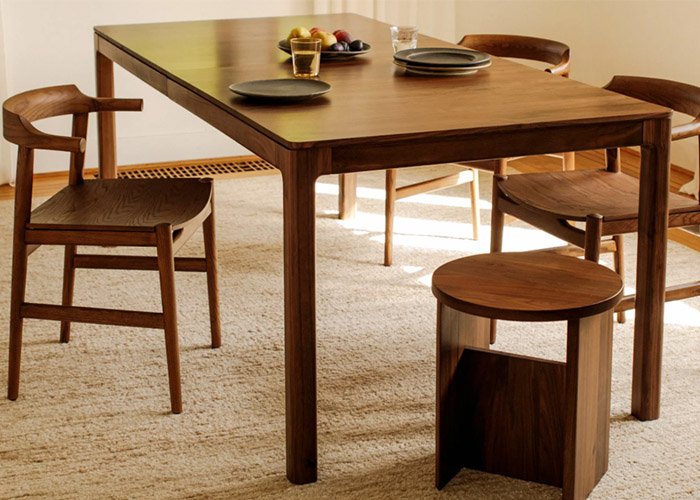
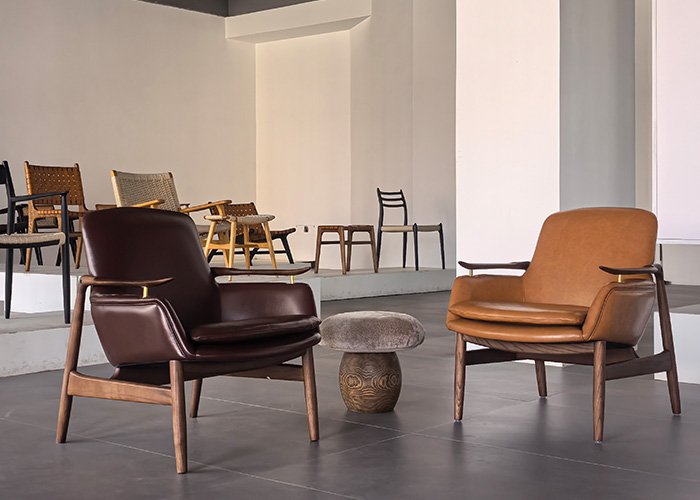
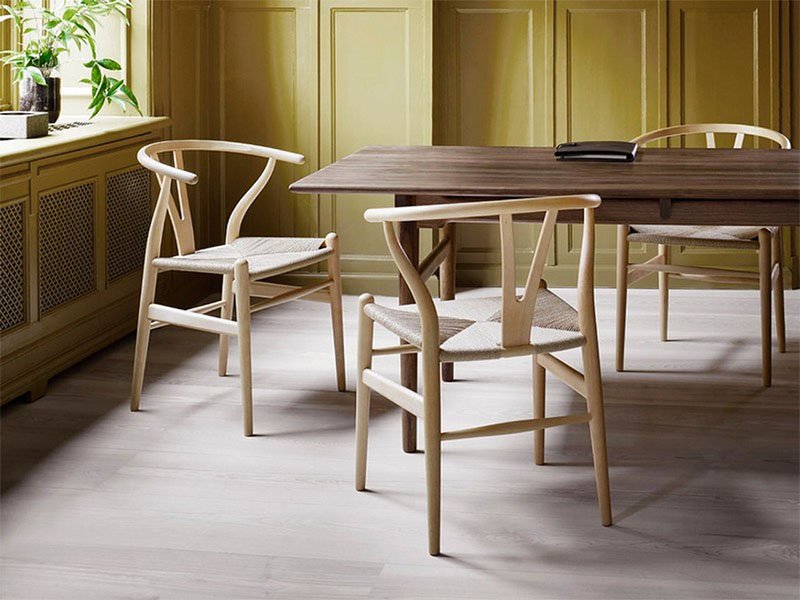
The 1st one it’s wisbhone chair made in natural ash,2nd photo it’s ashwood with walnut stain, 3rd photo it’s wishbone chair made in real north american walnut.


Q2. Do Y Chairs last?
Short answer: a well-made one does — think in decades, not seasons.
The original CH24 chair has been in continuous production since 1950, and chairs from the 1950s and 60s are still in daily use. That longevity is not luck; it comes from the construction (see Q3) and from the fact that there is very little to break: no mechanisms. A worn seat can be re-woven and a tired finish can be re-oiled, so the chair is repairable rather than disposable.
For a well-made solid-wood reproduction, a reasonable expectation is 8–15 years of daily use before any joint needs attention, with the paper-cord seat typically re-woven sometime after 10–20 years depending on how hard it is used. Cheap dowel-jointed versions often show looseness within 2–3 years — which is exactly why the joinery question matters more than the finish.
Q3. How to make a Y Chair — and why the process decides the quality
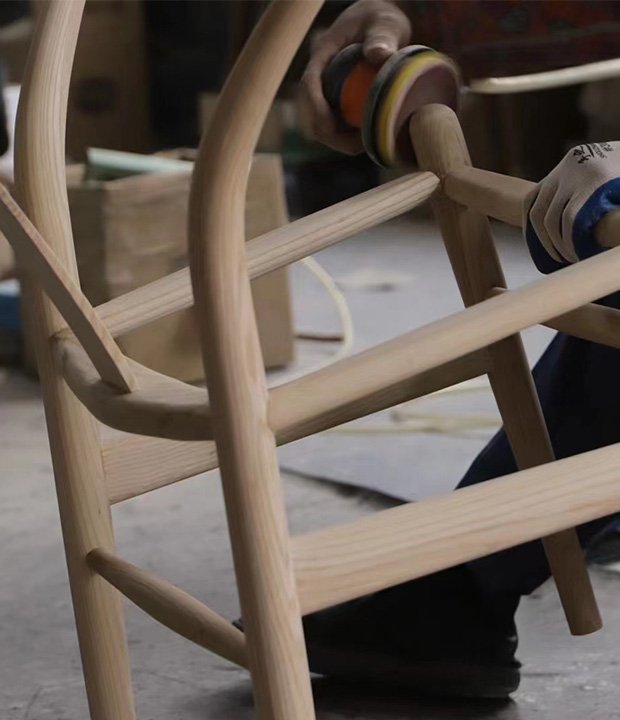
This is the question we like most, because the chair’s beauty is its manufacturing process. The original takes more than 100 production steps. The critical ones are these:
- Kiln-dried, seasoned heartwood. Moisture content must be brought down and equalised before machining. Skip this and the chair will move, twist and crack later — the number one cause of failures in cheap copies.
- Cutting and shaping the components. The frame is made of around fourteen individual parts: four legs, the curved top rail, the Y splat, and the side and back stretchers. Each is turned, shaped and sanded to size.
- Steam-bending the top rail and arms. The continuous curved rail that runs from the back around to the armrests is steam-bent from a single length of wood, then cooled in a former so it holds the curve. Bending breaks the fibres less than cutting the shape, which is why the rail stays strong. This is also the most expensive step to do properly — low-cost versions glue the curve together from segments instead.
- Mortise-and-tenon joinery, glued and assembled by hand. Every leg-to-rail and stretcher joint is a pegged mortise and tenon. There are no visible screws, no metal brackets, no dowel-only shortcuts.
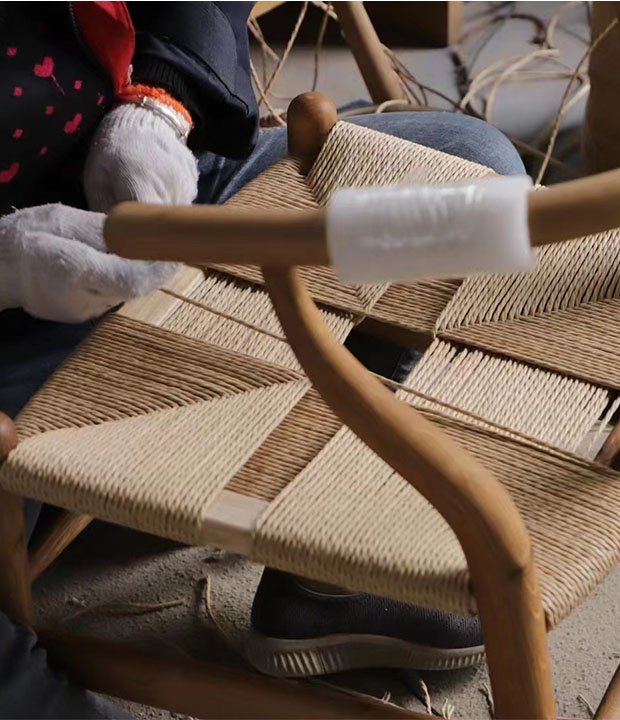
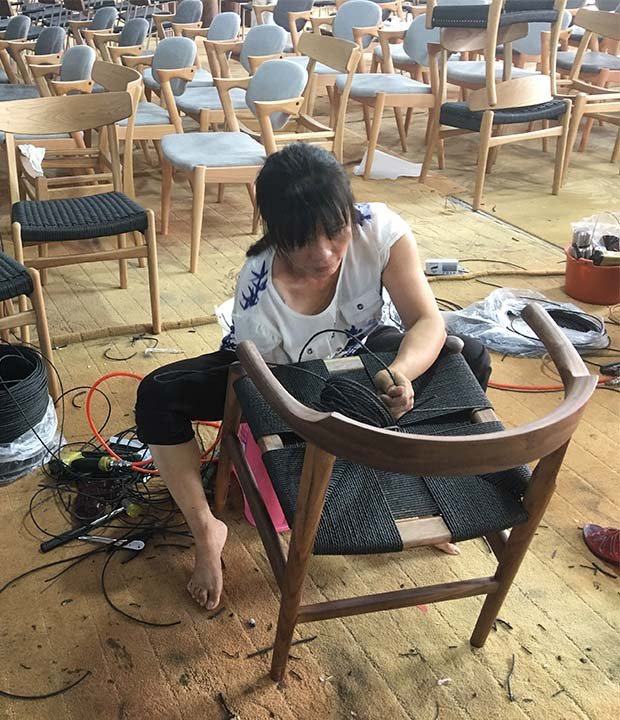
- Hand-weaving the seat. About 120 metres of paper cord is woven into the characteristic envelope pattern — roughly an hour of work per chair (see Q6).
- Finishing: oil, soap or lacquer. The frame is sealed so it can be maintained for years rather than coated in a thick film that chips.
The takeaway for buyers: the Y-shaped back is not decoration — it is the structure. A chair that saves money on the bending and the joints saves money on the only parts that actually hold you up.
Q4. What is a Y Chair, exactly?
The Y Chair — also called the Wishbone Chair, model CH24 — was designed in 1949 by the Danish cabinetmaker Hans J. Wegner and has been made by Carl Hansen & Søn since 1950. It is named for the Y-shaped (wishbone-shaped) splat in the backrest.
Its inspiration is Chinese rather than Scandinavian: in the 1940s Wegner studied the Ming-dynasty horseshoe-back armchair and spent years paring it down, replacing the solid back panel with two angled struts that both support the top rail and open up the space behind your back. The result is a dining chair that is light, low-armed enough to slide under a table, and visually quiet enough to disappear into almost any interior.


Q5. What kinds of wood can be used for a Y Chair?
Short answer: almost any stable, straight-grained hardwood — but each species changes the look, the weight and the price.
| Wood | Look & feel | Good to know |
|---|---|---|
| Beech | Pale, even, fine-grained, soft-looking | The classic choice, and the best base for painted or stained colours because it takes pigment evenly |
| Oak | Bold grain, warm tone, visible medullary flecks | Ages to a deeper honey-brown; the most popular “natural” look |
| Ash | Similar to oak but with a more pronounced, lively grain | Strong and flexible — excellent for steam-bent parts — and usually a little lighter in weight |
| Walnut | Rich chocolate-brown, straight grain | The premium option; makes the chair a statement piece rather than a background one |
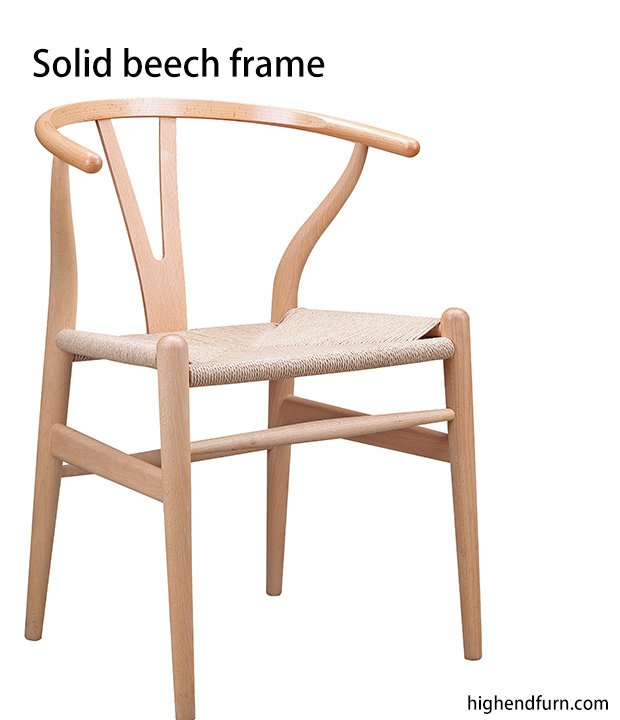
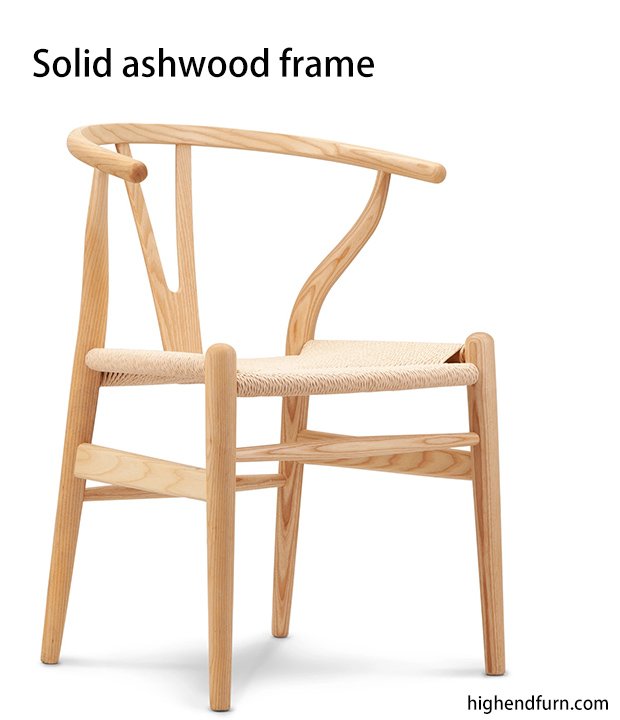
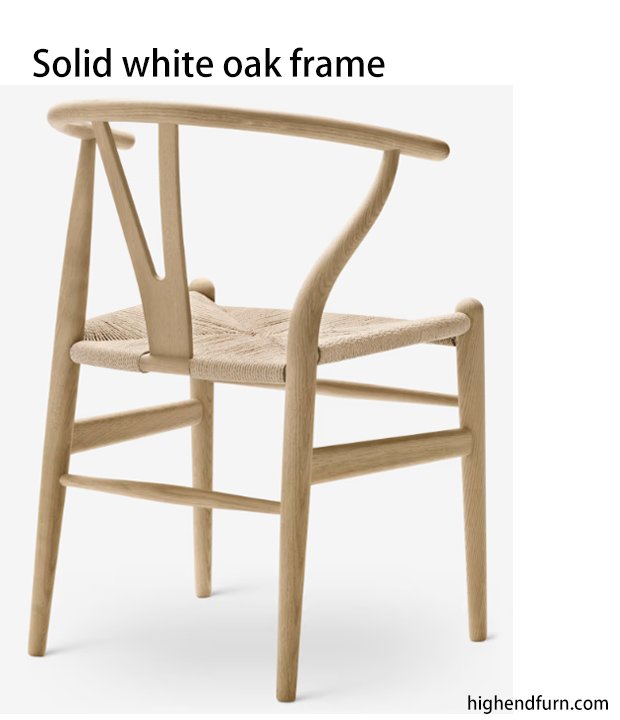
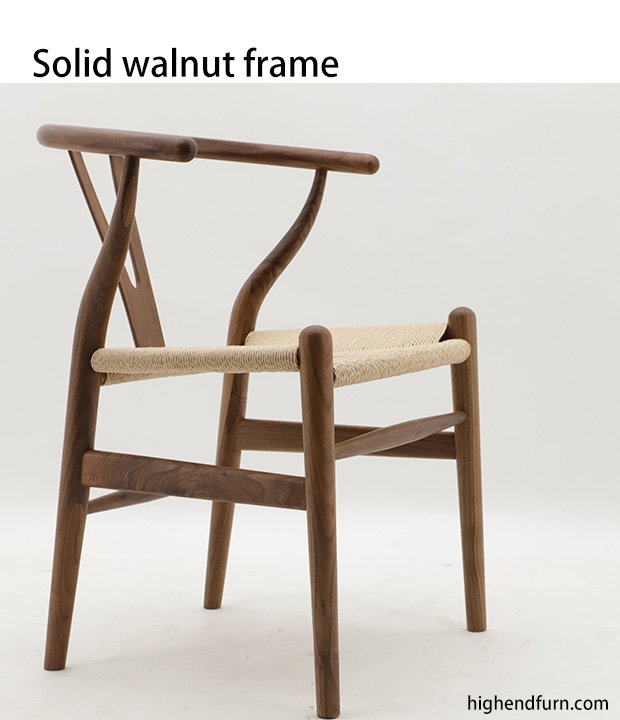
Whatever the species, check three things: it should be solid wood (not veneer over rubberwood or MDF), kiln-dried, and finished in oil, soap or lacquer rather than thick polyurethane.
Q6. Isn’t a paper-cord seat fragile?
Short answer: no — paper cord is tougher than it sounds, and it can be re-woven.
Paper cord was born of wartime scarcity in Denmark, when metal and cane were unavailable, so furniture makers twisted treated paper fibre into cord. They kept using it after the war because it turned out to be durable, slightly springy, and comfortable: it moulds itself to the sitter over time instead of sagging like cane or stretching like fabric. About 120 metres go into one seat and, with normal care, a hand-woven seat is expected to last decades before it needs re-weaving.
What does damage it is neglect rather than use: prolonged wetness, direct outdoor exposure, and sharp objects or pet claws. Spills should be blotted up quickly, not left to soak in.
Q7. Is it comfortable for long dinners?
Most people find the seat itself surprisingly comfortable — the cord gives a little, breathes, and warms to your shape. Opinions differ more on the backrest. The Y splat sits just below the shoulder blades and gives light, flexible support rather than a deep lumbar hug, and the rail behind it is a fairly slim curve.
- If you like an upright, perched seating position, you will probably love it.
- If you slouch, or you sit for hours at the table, add a slim seat cushion or a small back cushion — this is normal, and the original manufacturer sells an optional cushion for the same reason.
- Always test one before buying six. Buy a single chair first, live with it for a week, then complete the set. Returning a full set of dining chairs is expensive.
Q8. What size is it, and will it fit my table?
Reference dimensions for the classic CH24 chair: width 56 cm · depth 50 cm · height 74 cm · seat height 43 cm · weight about 5.2 kg. Reproductions vary slightly, so confirm the actual measurements of the model you are buying.
- Table height: aim for roughly 28–30 cm between the tabletop and the seat — a table around 73–75 cm high works well with a 43 cm seat height. Measure your table before ordering.
- Spacing: allow about 60–65 cm of table edge per chair. 6 chairs sit comfortably around a 180 cm table.
- Storage: Wishbone chairs can be packed 1 pcs/carton, or 2 pcs/carton.
- Weight: Around 5.2 kg they are easy to move one-handed — another reason they suit small apartments.
Q9. Original or reproduction — how do I tell them apart?
If you are buying a vintage original, the details matter. If you are buying a reproduction, an honest seller will simply tell you it is one. Watch for these checks:
- Price versus wood. A tiny price plus a claim of “premium ash or walnut” is a red flag; those species have a real cost floor.
- The rail and arms. On a good chair the curve is steam-bent from one piece, with no visible joints. Segmented, glued construction is the cost-cutting giveaway.
- The weave. Hand-woven seats are woven from the outside inward, in the envelope pattern, with slight natural irregularities at the edges. Machine-woven seats look mechanically even, often too tight or too loose.
- Weight and rigidity. Sit in it and twist gently. A solid, pegged frame feels like one object; a dowel-built copy creaks and shifts.
- Under the seat. Originals carry a maker’s stamp with the designer’s name; the underside should be clean, finished and free of rough edges.
- Seller transparency. Ask what it is. A seller who says “reproduction, solid ash” is more trustworthy than one who implies a licensed original at a bargain price.

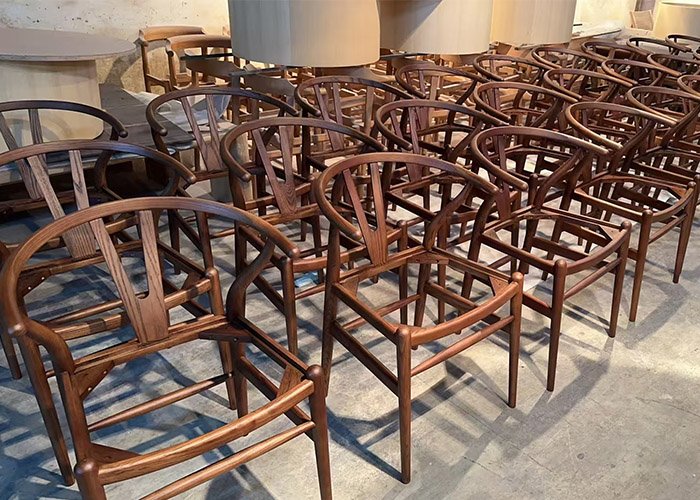
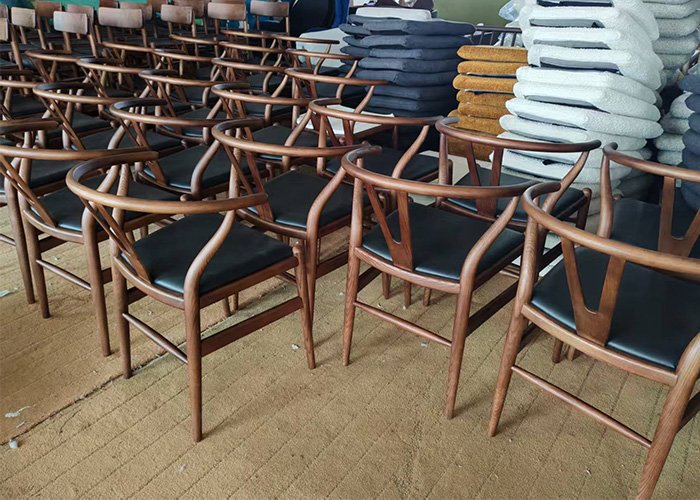
Q10. How do I clean and maintain the Y chair ?
| Situation | What to do |
|---|---|
| Everyday dust | Soft dry cloth, or a brush along the cord weave; vacuum the seat with a brush attachment now and then |
| Spills on the cord | Blot immediately with a dry cloth, then a barely damp one. Never soak, and do not use a steam cleaner |
| Oiled or soaped wood, lightly marked | A little natural soap dissolved in warm water, applied with a soft cloth along the grain, wiped dry with a clean cloth |
| Deeper marks or a dry-looking finish | Lightly sand along the grain with fine paper (#240–#400), then refresh with a suitable furniture oil |
| Lacquered or painted finishes | Damp cloth only — no abrasive pads, no solvent cleaners |
| Loose joint after years of use | Contact the supplier; a pegged tenon can usually be re-glued. This is a repair, not a replacement |
| Sagging or broken cord | Re-weave the seat rather than replacing the chair |
Q11. Can I use it outdoors or on a covered patio?
Short answer: no — it is an indoor chair.
Both the solid-wood frame and the paper cord react to moisture and to repeated wet/dry cycles. Humidity changes make the joints expand and contract, which loosens them over time, and the cord absorbs water. A short spell near an open window is fine; rain, sprinklers and coastal salt air are not. If you want the look outside, choose an outdoor-specific design instead.
Q12. Why the price difference — and what should I check before ordering?
The spread between a budget copy and a well-built chair is mostly labour and material: solid kiln-dried hardwood versus ashwood, steam-bent curves versus glued segments, hand-cut mortise-and-tenon joints versus dowels, an hour of hand-weaving per seat versus a machine-woven one, plus the finishing and the quality control behind them. None of that shows in a thumbnail photo — but all of it shows up in year three.
Your ordering checklist:
- Confirm the wood species and that it is solid wood, and ask to see a grain photo of the actual batch
- Confirm the joinery type and whether the top rail is steam-bent in one piece
- Confirm the seat is hand-woven paper cord, natural or black, and whether spare cord or re-weaving is available
- Check the exact dimensions against your table height and available space
- Ask about the finish (oil / soap / lacquer / painted) and how it is maintained
- Clarify packaging, lead time, and how damage in transit is handled — this chair is light but the arms are vulnerable
Looking at the CW8137 Y Chair?
Send us your target quantity, wood preference and finish, and we will come back with photos of the actual chairs, exact dimensions and a quote — usually within 24 hours.
Samples are available if you would like to see quality first.