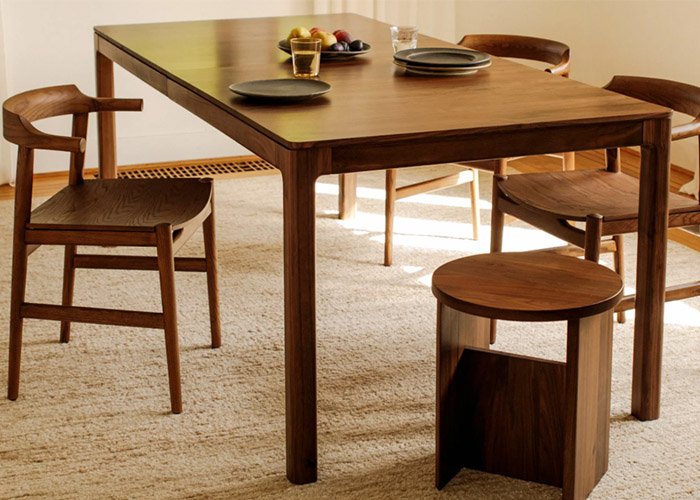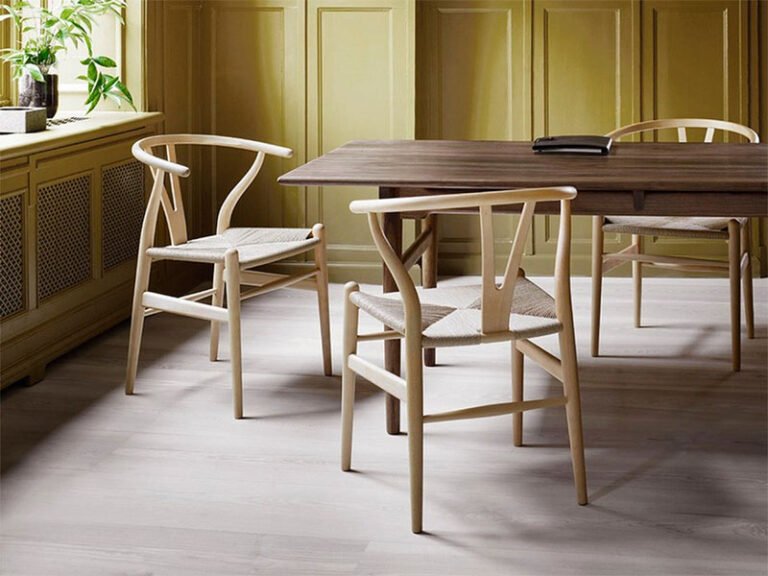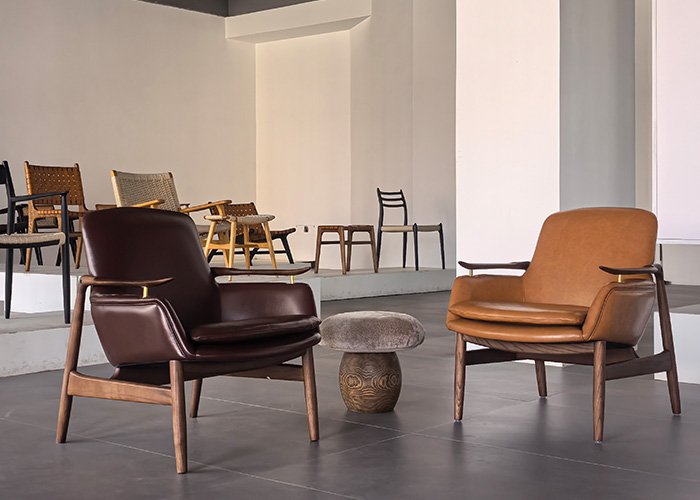

Choose the wrong wood type and the problem shows up eighteen months later: dented seat rails, hairline cracks across the apron, or a finish that has gone patchy around the joints. Choose well and the same chair is still tightening up nicely after a decade of service.
This guide compares the three species we build most often at Xin Yean furniture — ash, white oak and American black walnut — on the things that actually change your buying decision: hardness, how the wood machines into chair parts, how it takes a finish, what it costs, and how it behaves after a container voyage.
1. Hardness: what the Janka number does and does not tell you
The Janka scale measures the force needed to embed a steel ball halfway into the wood. It is a useful proxy for dent resistance, and that is all it is. It does not measure whether a chair is strong.
| Species | Janka (lbf) | Dent resistance | Typical chair use |
|---|---|---|---|
| White oak | ~1,360 | Highest of the three | Heavy-use family dining, restaurant side chairs |
| Ash | ~1,320 | Nearly equal to white oak | Shaped backs, bent components, spindle and Windsor styles |
| American black walnut | ~1,010 | Noticeably softer | Premium residential, low-to-moderate turnover interiors |
Read that table carefully and you will notice something counter-intuitive: walnut is the softest of the three and also the most expensive. Buyers new to solid wood often assume price tracks strength. It does not. Walnut costs more because the timber is scarcer and the yield per log is lower, not because the chair is tougher.
THE NUMBER THAT MATTERS MORE THAN JANKA
A chair’s real-world durability is decided by JOINT CONSTRUCTION AND COMPONENT SECTION, not by the species alone. A mortise-and-tenon frame in 1,010 lbf walnut with proper glue blocks will outlast a stapled and screwed frame in 1,360 lbf oak.
When you compare samples, twist the frame by hand and listen: a rigid, silent frame is the finding; a few degrees of flex and a faint creak is the defect.
2. Ash: the practical choice for shaped chairs
Ash is the workhorse of mid-century reproduction. It machines cleanly, bends well under steam, and takes stain evenly — which is why so many tapered-leg, curved-backrest and spindle designs are built in ash regardless of the colour they are sold in.
- Strength-to-weight: among the best of the domestic hardwoods, so legs can be slim without feeling fragile.
- Grain: bold, open and slightly coarse. It reads as “natural wood” even under a mid-tone stain.
- Staining behaviour: this is ash’s commercial superpower and its biggest disclosure issue. Ash is routinely stained to an oak or walnut colour. That is a legitimate finish choice — but the product must be described as ash with an oak-colour finish, not sold as oak. Require the species to be named per component in your purchase specification.
- Watch item: the open pore structure needs a properly sealed topcoat. A thin finish on ash shows wear at the high-touch points first.
3. White oak: the premium default
If you are building a range that needs to justify a higher retail price on material merit alone, white oak is usually the answer. It is the hardest of the three, it has a distinctive straight grain with prominent ray fleck on quarter-sawn faces, and buyers recognise the name.
- Appearance: lighter, cooler and more neutral than ash. It suits Nordic and Japandi interiors without looking bleached.
- Closed pores: tyloses make white oak far more resistant to liquid penetration than red oak or ash — a real advantage for dining chairs that see wine, oil and daily wiping.
- Finishing: takes fumed, oiled, soap and lacquer finishes well. Light oil-and-wax finishes show the grain beautifully but need reapplication every 6–12 months; a lacquered or polyurethane-sealed surface is close to maintenance-free.
- Cost position: typically 20–35% above ash for comparable component sections, varying with grade and market.
4. Walnut: the premium signal
Walnut is chosen for how it looks and ages, not for how it wears. The colour ranges from pale chocolate to deep brown with purple and grey streaks, and it deepens rather than fades with time.
- Positioning: the strongest material-based retail story of the three. A walnut frame lets you price a chair as a design object rather than a commodity.
- The trade-off: lower dent resistance. In a home dining room this is a non-issue. In a restaurant running four-plus turns a night, or a hotel breakfast room with chairs dragged eight hours a day, it will mark — and the marks read more clearly on dark wood than on light.
- Grain matching matters more than on oak. Walnut’s figure is expressive. On a run of 500 chairs, poorly matched components look noisy. Ask how the factory sorts and books components before machining; ask to see a photo of a full production batch, not just the sample chair.
- Veneer or solid? On curved backs and shaped aprons, some manufacturers use walnut veneer over a substrate to control cost and eliminate movement. That is a legitimate construction — but it must be disclosed. A chair advertised as “walnut” with no construction note should be assumed solid until the spec sheet says otherwise. Get it in writing.
5. The question buyers ask us most: “can I get the walnut look for less?”
Yes, and there are three honest routes. Ranked by how close they get:
- Ash with a walnut stain — closest visually at a glance, structurally the strongest option of the three, and the most common solution for mid-price ranges. The tell is at the cut edges and inside the frame, where the pale ash shows through.
- Rubberwood with a walnut finish — the budget route. Serviceable for moderate residential use, but lower indentation resistance, so avoid it on exposed arm tops and seat rails.
- Walnut veneer on shaped components — good where curves make solid walnut impractical, weaker if the chair takes a knock on an edge.
All three are fine products. None of them is “a walnut chair”. The distinction costs you nothing at the sampling stage and is expensive at the complaint stage.
6. Moisture content: the check that prevents most after-sales claims
Wood that goes into production too wet will shrink, and shrinkage after delivery is what produces gaps at the joints, cracked aprons and the dreaded “my chairs arrived with splits” email. For furniture going to North America or Europe, target a moisture content of roughly 8–12%, matched to the destination climate rather than the factory’s.
What to ask for, in order: a kiln-dried timber declaration for the batch; moisture meter readings taken at the machining stage, not the warehouse; and acclimatisation time in the finishing area before coating. A factory that keeps those records will show them to you immediately. A factory that hesitates is telling you something.
7. A specification checklist you can send to any supplier
- Name the botanical species for each structural component — frame, legs, backrest, seat substrate — not just the chair as a whole.
- State whether each component is solid, veneered or stained, and record the exact finish name or code.
- Agree the moisture content range and the measurement method.
- Specify joint type (mortise and tenon, dowel count per joint, glue blocks, corner reinforcement) and any metal hardware. Confirm the hardware brand — it is the most common silent downgrade after sample approval.
- Require an approved sample with a declared grain and finish standard, plus a signed batch-variation tolerance.
- Ask for finished-chair strength and durability test evidence appropriate to the market: BIFMA/ANSI for office seating, EN 16139 or BS 4873 for contract seating in Europe, CAL 117 or BS 5852 for foam flammability where the project requires it.
- Agreement on packing before the order: carton dimensions, whether nested or KD, corner protection, and the resulting pieces per 40HQ. This number changes your landed cost more than a small unit-price difference does.
8. Our recommendation, by project type
| Project | Lead species | Why |
|---|---|---|
| Family dining, retail range, resale | White oak | Hardest of the three, name recognition, light neutral tones sell |
| Mid-century shaped or spindle designs | Ash | Bends and machines cleanly, tough, takes any stain |
| Premium residential, design-led interiors | Walnut | Unmatched colour depth and ageing |
| Restaurant, 3+ turns per day | Oak or ash + commercial PU or treated fabric | Dent resistance and cleanability beat appearance of ageing |
| Boutique hotel, lounge and F&B | Walnut or walnut-stained ash | Moderate traffic, brand image leads, maintenance is on staff |
Frequently asked questions
Is ash better than oak for dining chairs?
Neither is better outright. Ash is easier to shape into curved components and costs less; white oak is slightly harder, more resistant to liquid penetration, and carries a stronger retail name. Choose ash for shaped mid-century designs, oak for a straight-grained premium natural look.
Are walnut dining chairs weaker than oak ones?
Walnut is softer — about 1,010 lbf against oak’s roughly 1,360 — so it dents more easily. It is not automatically a weaker chair. Joint construction, component dimensions and manufacturing control decide whether any chair meets its intended load requirement.
How can I tell if a “walnut” chair is actually stained ash?
Look at the inside of the frame, the underside of the seat rail and any cut edge: stained ash shows pale timber where the finish has not reached. Then read the specification — a supplier willing to name the species per component has already told you the answer.
What moisture content should imported solid wood chairs be?
Around 8–12% for North American and European destinations, matched to the end climate. Ask the factory for batch meter readings and evidence of acclimatisation before finishing.